Knowledge Center
20 Advanced Turkey Hunting Techniques to Use This Spring
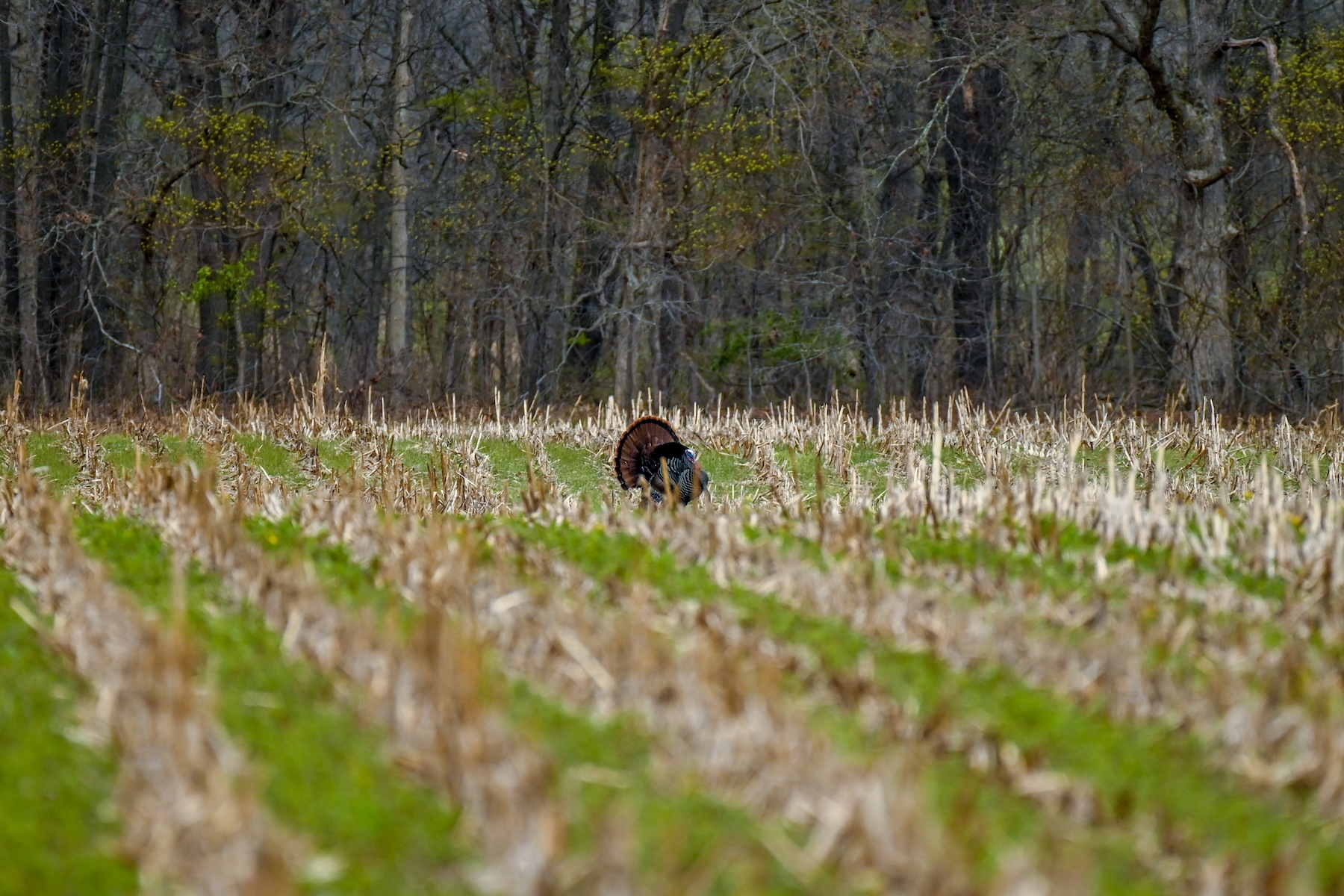
Wild turkeys might have pea-sized brains, but they aren’t dumb. Nor are they easy to kill. It takes skill to “unalive” these things.
Unsurprisingly, new turkey hunters take some time to grasp entry- to moderate-level concepts. As with anything, learning starts slowly and exponentially increases as more experience is gained. Eventually, with some seasons under their belt, it’s time to focus on absorbing advanced turkey hunting tips and techniques. Want the latest in turkey hunting tactics? Read on for expert turkey hunting advice.
1. Use Digital Scouting Techniques
Hunting apps and other digital tools are among the most effective means for modern turkey scouting. These assets are quite powerful and go well beyond the abilities of classic aerial and topography maps. Today, hunters have access to an array of tools, each of which serve numerous applications in the field.
General benefits:
● Use the blue location icon to keep track of your position in relation to property boundaries, selected hunting areas, etc.
● Study the “Property Info” to determine accurate land ownership, landowner data, and contact info.
● Keep track of the weather in real time and via forecasts that overlay your hunt area maps.
● Keep track of your position, and where you’ve been, with the “Track Path” feature.
● Use “Offline Maps” for areas with limited or no service.
● Implement the search function to find properties by name or landowner.
● Draw “Lines” and other “Shapes” for a variety of tasks, such as property management (i.e.: food plot shapes).
● Gauge distances and area with the “Measure Distance” and “Measure Area” features.
● Buy hunting gear at a significant discount.
Mapping benefits:
● Deploy an array of base layers that focus on satellite and topographic imagery.
● Use base layers that offer 3D, Lidar, and other accurate terrain and topo depictions.
● Run layers that show monthly changes in the landscape for near-real-time scouting.
● Scout private lands with the “Property Line” feature.
● Study public properties with the “Hunting Lands” and “Public Lands” overlays.
● Gauge habitat with the “Crop History,” “Soil Classification,” “Tree Cover,” and other overlays.
● Study changes in terrain with the “Contour” overlay.
● Determine cell coverage for cell cams with the “Cell” overlay.
● Find water via the “Water Features” overlay.
General dropped-pin benefits:
● Parking areas
● Trail cameras
● Hunting blinds
● Food sources
● Food plots
● Water sources
Turkey scouting related benefits:
● Droppings/scat
● Dusting areas
● Gobbles heard
● Feathers
● Roosting area
● Roosted gobbler
● Scratching
● Strutting area
● Tracks
● Turkey sighting
● Wing tip marks
● Etc.
Obviously, modern hunting apps are loaded up with exceptional value. Truthfully, they’re worth more than what’s commonly charged. It’s a no-brainer to subscribe to one or two of these each year.
2. Capitalize on Advantageous Terrain Types
Turkeys, like all wildlife, benefit from certain terrain features. Also, they gravitate to key land characteristics that are beneficial for them. Examples of terrain turkeys love include benches, bottomlands, draws, edges, fields (big and small) flats, hills, hollows, ridges, pinch-points (funnels), ridge endings (ridge points), ridge spurs, swamps, waterways, and more. Ultimately, if it serves well as a roost site, landing zone, food source, water source, strut zone, travel route, nesting cover, brooding cover, etc., turkeys will likely be there. The great turkey hunters find these areas and hunt such spots when it makes sense to.
3. Understand How Turkeys Use Various Habitat Types
Turkeys use a variety of habitat types. They love mature timber for roost sites and feeding areas for scratching. Thicker cover serves as excellent nesting and brooding habitat. Open fields offer great locations for bugging and other food sources. When turkey hunters completely understand how turkeys use different areas, and when, it’s much easier to anticipate their next move.
4. Set Up on the High Ground
Ask any seasoned turkey hunter, and it’s much easier to call a turkey uphill than downhill. Maybe they like the climb. Perhaps they’re scared of stumbling, rolling downhill, and looking silly in front of their friends. But it’s probably that they benefit from the retreat back downhill if they get their butt whipped. It’s easier to escape downward than upward. Therefore, when possible, experienced turkey hunters set up on the high ground.
5. Deploy Cellular Trail Cameras to Scout Turkeys
Those who aren’t using their Reconyx trail cameras to scout turkeys are missing out. Deploy cellular trail cameras for near-real-time, in-season scouting results. Of course, check your state and local hunting regulations to ensure hunting law compliance. That said, where permitted, these offer highly valuable wild turkey intel.
6. Use Various Calls and Call Types
Some turkey hunters use only one or two turkey calls. Those who’ve been around the block know that’s a mistake. Instead, they carry various calls, including multiple options in the diaphragm (mouth), box, glass, slate, and other friction calls. These all offer different sounds and volumes, and each gobbler might like and respond to one but not another.
Each call type sounds different. A box call sounds different from a slate, diaphragm, etc. Even within the same call type category, such as mouth calls, these sound much different from one to the next. Call shape, call size, reed cut designs, and much more, impact overall sound.
7. Learn the Proper Nuances of Implementing Each Call Type
Next up, it’s good to learn the proper nuances of implementing each call type. For example, with mouth calls, most new turkey hunters attempt to blow air across their tongue and along the top of the call. Instead, the proper method is to use your diaphragm (in your torso) and “huff” air out and over the reeds. There should be less tongue movement and more jaw action. Then, use your tongue for the slighter and more nuanced motions needed to fine-tune the sound of your calling.
Maybe your preferred call is a glass or slate pot call. If so, hold the pot with your non-dominant hand. Grasp the striker with your dominant one and hold it as you would a pen. Then, with about a 45- to 50-degree angle, make the relevant motions for your preferred turkey vocalization. Make small circles or short lines, and maintain consistent contact on the call surface, to project the call. Generally, more pressure translates to a louder and higher pitch, and less pressure produces a softer and lower sound.
8. Mimic the Right Turkey Vocalizations at the Right Times
Each turkey vocalization means a very different thing. Because of this, turkey hunters must translate the meanings, understand the application, and then mimic the right turkey vocalizations at the right times. Fail to do that, and you might be saying, “Oh, crap, there’s a bobcat!” When you really meant to say, “Oh shucks, you sure look sexy.”
9. Implement the Right Type of Tree Talk
Too many turkey hunters come on way too strong while turkeys are on the roost. Don’t do that. Because turning your call up to 10, or even 5, is the equivalent of rolling over in bed and yelling at your spouse, “Hey! It’s time to get up!” They don’t like that, and turkeys don’t, either. Loud calling before sunrise gets sideeye, at best. Instead, call softly and sparingly with a few soft clucks and tree yelps.
10. Understand That Sometimes, Less Calling Is Better
Rarely is more calling better than less calling. It’s better to tone it down and launch fewer vocalizations into the atmosphere. Sound like a hard-to-get hen, rather than the super-easy promiscuous type.
“You know, usually, less is more,” said Dave Skinner, a Whitetail Properties Land Specialist in Central Kentucky. “Sometimes I struggle with that, but less and softer calling is better, especially as the season progresses.”
Sometimes, you’ll strike a hot gobbler and hammer the first 2-year-old tom that comes running. You’ll lay the hammer down, sling that bird over your shoulder, and feel like a wilderness king.
But, you know, as a season progresses, and sometimes right out of the gate, turkeys don’t act the way hunters hope they will. The turkeys get wiser, react less excitingly, and overall, the hunting gets harder.
11. Start Low and Ramp Up Calling From There
Starting with loud calling is the wrong choice approximately 99% of the time. Instead, begin with softer calling. Use quieter, lower tones. If that doesn’t produce the desired result, ramp up calling from there. Starting quiet and getting louder poses minimal risk. Start loud and you might see adverse reactions.
12. Keep a Hot Bird Talking, and Then Go Quiet
That bird is gobbling more than a hairdresser who lives for gossip. It has a true case of diarrhea of the mouth. Even so, it won’t budge from that strut zone, food source, or group of hens. If that hot bird keeps talking, but won’t commit, go quiet all at once. Playing hard to get might make the difference.
13. Use Non-Verbal Calling Sounds
You have more than turkey calls at your disposal. Oftentimes, non-verbal calling can be just as effective. For pressured turkeys, it can be even more productive.
“Try some soft-calling, scratching in the leaves, and maybe the flick of a turkey wing,” Skinner said. “I carry a wing around with me. It’s way more effective than yelping your head off.”
Maybe that's just basic turkey hunting advice. Perhaps it isn’t advanced at all. But even experienced hunters need that reminder, because they often refuse or forget to follow it.
14. Hit That Mouthy Hen with Some Sass
Can’t pull that boss tom from its flock of hens? Maybe one of the hens is yapping its head off? Hit that mouthy lady with some snarky turkey talk. Give her some sass. Sometimes, if you repeat the hen’s vocalizations, and occasionally cut her off mid-sound (ladies don’t like that), it can make her mad enough to come looking for you. Generally, the gobbler is in tow.
15. Take Your Decoying to the Next Level
Simply staking a hen decoy in the field and hoping for the best isn’t exactly “advanced” turkey decoy technique. Rather, analyze the nuance of the situation. Is it early season? Position a strutter decoy with a hen. During mid-season, use a jake and hen. It’s late season? Use a lone hen or group of hens.
Are you gun hunting? Face turkeys away so they aren’t “looking” at your position. Bowhunting? Face male decoys toward you and hen decoys looking away, so that you can draw while that longbeard is in full strut and looking away from you.
16. Stash Your Tail Fans Meant for Reaping
In some cases, it pays to quit using a tail fan. These are seemingly less productive as time goes on. That’s especially true in areas with a lot of predators, matured turkey populations, and heavy hunting pressure.
“Something else that I've learned the hard way is putting the tail fan to rest,” Skinner said. “Back in the day, I was a huge advocate of the tail fan. I can't even tell you how many turkeys I killed running wide open at me to a tail fan. But I do not get the response from it as I once did.
“Maybe it has something to do with the decline of the turkey population,” Skinner continued. “Or maybe the birds are getting smarter. But if they were going to stop responding to calls, they would have done that a long time ago.”
Of course, turkeys still respond to fans, just as they respond to calling and decoying. It isn’t the same as it was 10, 15, or 20 years ago, though.
“Seeing a high percentage of gobblers flat-out running in and stomping your guts out — that just doesn't happen anymore,” Skinner said. “I’d say it's time to revert back to those old-time tactics where you locate a bird that’s gobbling, and you set up.”
17. Don’t Run and Gun Quite so Hard
The run-and-gun turkey hunting tactic has its place. Used wisely, it’s great for killing wild turkeys. However, you should quit using it so much. Instead, be more stationary. Sit and wait for two or three hours, rather than 20 or 30 minutes. Oftentimes, being patient proves more effective than being on the move. You’ll also spook fewer birds.
18. Track a Gobbler’s Movements and Circle Ahead
Some turkeys won’t commit no matter the tactics used. For these birds, track their movements, anticipate their projected destination, and circle ahead. Use the habitat, terrain, and topography to your advantage. Set up where you think the turkey will go. That’s the best move for stubborn gobblers.
19. Find a Willing Gobbler
Can’t seem to see or hear a turkey no matter what you do? Being patient and sitting in one spot isn’t working, either? If nothing is producing, go on a wild turkey walkabout. Keep moving until you finally find birds. Then choose tactics accordingly.
20. Hit Turkeys with a One-Two Calling Punch
Lastly, for turkeys that are especially challenging to call, hit them with a one-two calling punch. If alone, call from a distant position, and (cover permitting) charge straight ahead to cut some distance. If with a partner, have them drop back and call the bird “through” the shooter’s position.
“Maybe consider tag-teaming with a hunting partner,” Skinner said. “Because they're getting even harder to hunt, it helps if the second guy is set up a little further away than the main shooter. Then, they do most or all of the calling.”
No matter your status as a new or experienced turkey hunter, have fun this spring. For some, it’s already time. For others, it soon will be. But for all, turkey season will fly by far too fast.