Knowledge Center
How to Identify and Remove Buckthorn on Your Property
Imagine a big shrub that takes over everything from prairies to woodlands to even some wetlands. That’s buckthorn, and it’s invading the United States. Given the scientific name of Rhamnus cathartica, Buckthorn sometimes goes by other handles, including common buckthorn, European buckthorn, hart’s thorn, waythorn, etc. It is a highly invasive species, and it’s closely related to others, including the Alder buckthorn, California buckthorn, Carolina buckthorn, Chinese buckthorn, Dyer’s buckthorn, glossy buckthorn, and more.
What Is Buckthorn
Buckthorn is an invasive species in North America. According to the University of Minnesota, it arrived in the U.S. in the 1850s. It traveled by sea from Europe and has been a nuisance ever since. At the time, it was intentionally introduced as an ornamental hedge but has spread rapidly over the past 175 years.
“Buckthorn is native to Europe and parts of Africa, and it's highly invasive,” said Adam Keith with Land & Legacy. “It’s a shrub or small tree in the north, northeast, and Great Lakes regions. It's more of a northern climate invasive that we deal with. We don't see it a lot in the lower Midwest or mid-Atlantic, although it's not completely out of those areas.
“I see the most in the Dakotas (especially North Dakota), Minnesota, Wisconsin, Michigan, northern Indiana, and Ohio,” Keith continued. “It's even in New York.”
Today, it outcompetes preferable native species. It threatens vital habitat types, including prairies, forests, wetlands, etc. Furthermore, it smothers ground-level plants that assist with soil erosion, effectively worsening soil displacement problems. It even plays host to pests and funguses. No doubt, it continues to degrade our wild places.
Buckthorn can be found anywhere from open fields to inside mature forests. The buckthorn plant is a hardy species and can even grow well in understories where most other plants will not. It’s known to grow well in dry and moist soils but does not do well in flood-prone areas. It thrives from mostly shaded locations to areas with full sunlight. It accepts a wide range of habitat types.
“If the woodlot was once more of a woodland, not so dense or closed canopy, you'll see it a lot in the mid-story,” Keith said. “Primarily, I find it in the areas that are turning back to wooded acreages, glades that are no longer being burned, pastures that are no longer being grazed, and crop fields that are no longer being planted.
“You see it a lot in old fields or areas turning back into wooded areas,” Keith continued. “So, young forests, old fencerows, and areas that were once open, like fallow fields or crop fields from 30 years ago that have been left alone — that's where it establishes.”
How to Identify Buckthorn
Buckthorn is best described as a shrub or small tree. It reaches up to 25 feet tall. The canopy takes on an oval shape. It’s a very top-heavy-looking growth style.
“I see it most of the time with my job during the dormant season,” Keith said. “I'm looking for a tight bark, but it’s easily distinguished by the thorns. It has some similarities to hawthorn, but not quite as needle-like thorns. Rather, the main little twigs on the branches turn into thorns, so you definitely don't want to rub up against them during the growing season.”
Those unfamiliar with buckthorn won’t take long to learn how to identify it. Deer hunters need only remember that the end of the twig produces a deer track shape. With two tree buds angling out, and a thorn between them, the plant is easily identifiable. (Thorns can also grow from the base of twigs.)
Leaves are dark green and oval in appearance. The edges have slight serration along the edges. Veins within the leaves curve up toward the tip.
“It has a circular leaf that’s really dark green and glossy,” Keith said. “The gloss is probably what I identify the most during the growing season.”
The bark is smooth. It’s gray to dark brown. The lenticels are horizontal and silvery. The interior of the wood has yellow sapwood and orange heartwood. Berries are black and peak in late summer to early fall.
Early spring and fall are excellent times to identify this plant. These trees put on leaves early in spring and hold onto them later in fall. However, buckthorn looks similar to some native species, so ensure accurate identification before removing buckthorn trees.
How to Remove Buckthorn
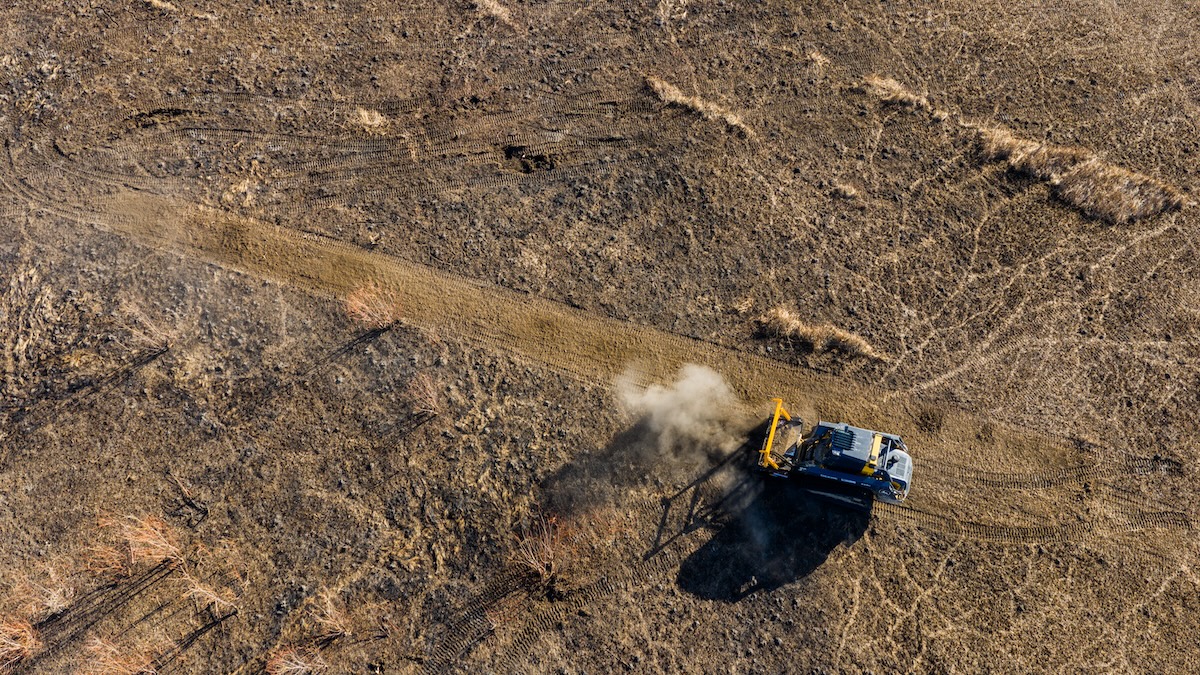
The best thing you can do with this nasty invasive? Learn how to get rid of buckthorn. Crank up your John Deere, hook up a Quick Attach implement, and start ripping it out of the ground.
“We see guys who are pulling it with skid steers and tree pullers,” Keith said. “If we're talking about small trees and large shrubs that are 15 feet tall, with a trunk or stump that is 3 to 6 inches in diameter, hack-and-squirt is probably the most effective way.”
Of course, the best method for buckthorn removal varies based on size, location, available tools, etc. Fortunately, land managers have several methods and resources at their disposal to handle the issue.
Small stems, such as ½-inch or less, can oftentimes be removed by hand. When small enough, these can be pulled up. They shouldn’t re-sprout. When stems are ½ to 2 inches in diameter, deploy a hand tool or implement that pulls the tree up and out by the root. In some cases, it’s also possible to spray growing-phase seedlings with herbicide, such as Glyphosate.
For buckthorn stems that are greater than 2 inches, it’s best to cut these and treat the stump. The best timeframe for this is late summer into fall. Spring to early summer are not optimal times. Click here for a detailed guide on herbicides to use to control buckthorn, and how to implement each strategy.
Do not chip and spread removed buckthorn. The berries can still spread with this method. Instead, pile and burn removed plants to reduce the odds of unintentional germination.
“It's like a lot of other invasives,” Keith said. “It produces berries. Therefore, when birds eat the berries, that's how it spreads so prolifically. It's a little black berry you'll see a lot in the fall.”
Buckthorn Management Priorities and Timelines
It’s important to understand buckthorn management priorities and timelines. According to the Minnesota Department of Natural Resources, “Buckthorn management is a multi-year commitment. Most viable seeds in the soil germinate within two years. Your plan will depend on how much time you have and how dense your buckthorn is. Additional seeds can be introduced to the site by birds or other wildlife. For just a few small plants, your plan might be as simple as a weekend of pulling buckthorn seedlings and regularly checking to see if new plants have taken root each year.”
Of course, larger and denser stands of buckthorn involve different plans than smaller ones. For example, with a lot of mature buckthorn on the landscape, prioritize removing all berry-producing trees first.
Next, remove all remaining buckthorn that isn’t producing berries. This step is more relaxed and less timely, as there is lower risk of plant reproduction and spreading.
Lastly, after all buckthorn is removed, conduct regular checks to locate potential reemergence. Remove as detected. Buckthorn will return, and it requires long-term management to keep it at bay. Use of controlled burns on two- to three-year cycles assists with this effort, too.
Better Habitat Alternatives to Buckthorn
There are better habitat alternatives to buckthorn. For those wanting to replace buckthorn with better native alternatives, consider options that are not invasive. The Minnesota DNR, and others, recommend plants such as American hazelnut, chokeberry, high-bush cranberry, nannyberry, pagoda dogwood, etc.
“A lot of people see it, especially deer hunters, and think it’s good habitat,” Keith said. “Deer like to be around it. It's prolific, grows quickly, and spreads rapidly.
“Some might see it in pastures and woods, see these shrubs, and think all this is great deer habitat. In that same region, that are a lot of shrubs that are just as or more beneficial,” Keith continued. “Obviously, they are even better since they are native, such as the viburnum family, the nanny berries, some of the plums, and dogwood — those are all great replacements for it.”
Available Resources for Buckthorn Management
Those needing to make a change on their land should seek out available resources for buckthorn management.
“We hate Buckhorn,” Keith said. “It’s a top invasive in the northern climate. Anything that's a shrub and grows a berry is either a huge problem or a wonderful native. In this case, it's non-native and it's a horrible problem.”
Those needing assistance with buckthorn removal can benefit from available resources. Contact your local Farm Service Agency (FSA), Natural Resources Conservation Service (NRCS), or other regulating organization. Cost-share programs might be available.