Knowledge Center
Deer Teeth Aging Explained: How to Tell a Deer’s Age After the Shot
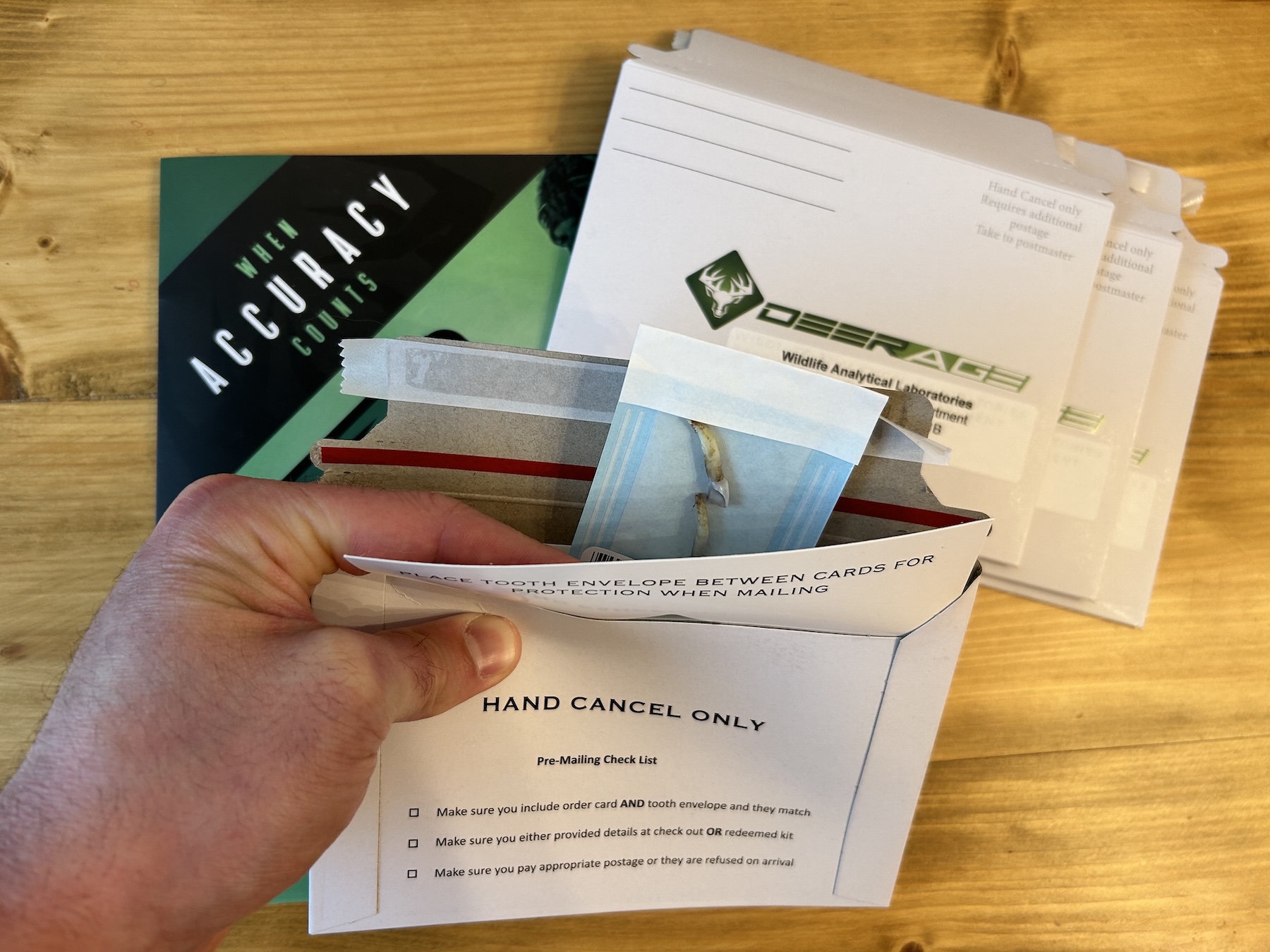
A hunter studies a jaw bone using the tooth replacement method. A biologist does the same but implements the tooth wear process. A lab tech analyzes the root of an incisor and deploys the cementum annuli angle. All three have their places, and all are excellent for aging deer.
Modern deer hunters take great pride in prioritizing deer management. For many, that includes aging deer on the hoof before sending a bullet or arrow downrange and then determining the age of harvested deer afterward. Of course, that requires knowing how to age a deer by teeth.
How Deer Teeth Change Over Time
Whitetails, like most animals, exhibit key changes over time. That includes their teeth, which have unique and visible shifts in characteristics.
For example, fawns that are about six months old have only four or five teeth. The third tooth along the cheek displays three noticeable cusps.
Yearling (1 ½-year-old) deer have six visible cheek teeth. That said, the third tooth, which is called the premolar, still only has three cusps. These teeth are temporary and might show discoloration or breakage.
At 2 ½ years old, six teeth are still present. But the third tooth has two cusps, rather than three. This expresses permanence.
Then, once a deer reaches 3 ½ and beyond, its six teeth are permanent fixtures. Because no teeth are replaced now, the cusps on molars begin to show wear. The longer the deer lives, the more these teeth wear down. In time, these flatten. Later in life, the dentine, which is the darkened center of the tooth, becomes noticeably wider than the enamel, which is the whitened outer edge.
Of course, there are various ways to age deer post-harvest. Deer hunters, whitetail biologists, and land managers have access to different methods for classification.
Aging Deer Teeth Using the Jawbone Analysis Method
Most deer hunters and land managers age harvested deer by studying the jawbone. This is divided into two categories, though.
“The oldest and most prevalent method for aging whitetails is the tooth replacement and tooth wear processes,” said National Deer Association (NDA) Chief Conservation Officer Kip Adams. “The method that has been used the longest, and which is still widely used, is the tooth-wear and replacement technique. This is where you use the lower jawbone and assess which teeth have fully erupted.
“Then, you observe how much wear is on those teeth,” Adams continued. “That's what deer biologists across the United States have used for decades. They continue to use it today.”
Of course, the tooth-wear method doesn't cost anything. Adams notes that you can do it right on the tailgate of your truck or in deer camp.
“I can teach anybody in about 15 minutes to use this tooth replacement and wear method very accurately to age deer,” Adams said. “You can break them down into a few different age classes using this option.
“The tooth replacement technique is nearly 100% accurate for aging fawns, or deer that are 1 ½ or 2 ½ years old,” Adams continued. “That's why it's been so widely used, because it's perfect for those three classes of deer. Once a deer is at least 2 ½ years old, we use the amount of wear on the molars to estimate whether that deer is more likely 2 ½, 3 ½, 4 ½, etc.”
Beyond 4 ½, subjectivity certainly comes into play. At that point, it's no longer an exact science, because teeth wear a bit differently. Per Adams point, people wear their teeth a little differently, too.
Even so, research has found that the tooth replacement and wear method is highly accurate for deer that are 2 ½ and under. Of course, deer that are 3 ½, 4 ½, or older, are more subjective and less accurate. According to Adams, the tooth wear method is highly accurate to within a year of the deer’s actual age. That, paired with being free, is why biologists and land managers use it with such frequency.
Key Points to Remember:
● Fawns have only four or five teeth and the third has three sharp cusps.
● 1 ½-year-old deer have six teeth along the cheeks; the premolar still has three cusps, but they appear more discolored and damaged.
● 2 ½-year-old deer display lingual crests on each molar that are sharp and pointed. There is significantly wider enamel than dentine on the rear-most teeth (No 4, 5, and 6).
● 3 ½-year-old deer show dentine that’s much wider than the enamel. This is especially true for tooth No. 4. Plus, the cusp on tooth No. 6 is beginning to wear down more.
● 4 ½-year-old deer exhibit progressively wider dentine on teeth No. 4 and 5, which is often twice the width as the enamel on the teeth. Additionally, tooth No. 6 presents visible sloping along the rear-most edge.
● 5 ½-year-old deer, and especially those that are 6 ½-plus, have cheek teeth that are greatly worn. Oftentimes, these are flattened and minimal enamel is visible.
Once deer surpass the 5 ½ mark, the tooth wear method becomes highly inaccurate. At that point, you know the deer is very old, but it’s quite challenging to produce accurate estimates. Geographic location, and variations in diet, also impact efficacy.
Aging Deer by Teeth with the Cementum Annuli Process
For older animals, specifically deer that are 3 ½ and older, the more accurate method is the cementum annuli process. The cementum annuli method is known to be approximately 90%-95% accurate.
“For that, rather than using the teeth in the back of the lower jaw, we use the teeth in the front,” Adams said. “We pull those two front teeth in the middle and send the incisors to a lab.
“Unlike tooth replacement and wear, it's not free or immediate,” Adams continued. “We can't teach everybody to do it. It takes special tools to slice the root and stain it to decalcify. Then, you look at it under a microscope.”
According to Adams, the cementum annuli process is much like counting the growth rings in a tree. He says that all mammals lay down a layer of cementum each year. Folks in a lab can look at these, count the growth layers, and estimate how old that deer is.
It’s important to know the cementum annuli process isn’t 100% accurate, either. Typically, it’s slightly less accurate for younger deer but more accurate for older deer.
“Essentially, for deer that are a fawn up to 2 ½, the tooth replacement method is more accurate,” Adams said. “For deer that are 4 ½ and older, cementum annuli is more accurate. And for deer that are 3 ½, the accuracy is about equal for the two techniques.”
Why the Cementum Annuli Process Isn’t as Accurate with Southern Deer
Don’t automatically assume the cementum annuli route works for every deer, though. Adams makes note that the cementum annuli method isn’t ideal for whitetails in every state. While it’s true that most mammals lay down the layer of cement, this is done during a really stressful period of the year — winter.
“Deer must live in an area where they experience true seasons to have that stressed winter period,” Adams said. “This factor must be present to clearly produce and identify the different layers and years.”
This means that the cementum annuli process is less accurate for southern deer. Adams says that most professionals with these labs will tell you that the latitudinal line in the U.S. is somewhere around southern Missouri.
“If you live north of that, those deer are experiencing enough winter that they produce a really good layer of cementum annuli,” Adams said. “If you live below that line, lab confidence in their estimate is not nearly as high.”
Basically, if you send a tooth in from Florida, and another tooth from Pennsylvania, the lab will be significantly more confident in its estimate for the Pennsylvania deer. It’s all due to the harsher winters.
Labs That Offer Cementum Annuli Services
Most hunters and managers use Matson’s or Wildlife Analytical Labs for cementum annuli services.
“Matson’s Lab has a minimum fee of $75 for three deer,” Adams said. “If you have more teeth than that, it's a lower dollar amount per tooth.”
According to Adams, Matson’s has been the gold standard for a long time. They've been doing this the longest, and they're often considered the best.
“There's another lab in Montana called Wildlife Analytical Labs,” Adams said. “An employee who used to work for Matson’s owns that now, and deerage.com is its website. They do individual teeth for $35.
“I send every buck we kill at our camp to see how old it is,” Adams continued. “For really old does, we also send in incisors, because it's fun to see how old those antlerless deer get.”
Why You Should Age Every Deer You Shot
There are many benefits to aging deer. Track progress in the deer herd. Analyze age-to-weight ratios. Maintain detailed management programs. Install plans to harvest only older deer. Then, monitor compliance, improve education, and keep records for these programs.
“This is important, as all other harvest data collected from a deer can be accurately tied to an age,” Adams said. “If you're trying to have healthier deer and bigger deer, you need to know how old they are. As you measure body weights, you also should measure antler characteristics, age weights, and more.
“None of these metrics mean all that much if you can't assign it to a year,” Adams continued. “It can be the difference in determining if you shoot a 2- or 5-year-old 10-pointer.”
Obviously, harvest data is very important. It allows you to determine if your deer are getting healthier, or not. Again, Adams stresses the importance of tying body weight and other important categories to age.
To that point, Adams and company shoot a lot of antlerless deer on his farm in Pennsylvania. There, he says the average age doe in his area is 3 to 4 years old. There is heavy harvest pressure in the region, and some deer get hit on the roads. That hasn’t stopped them from shooting some really old does, though.
“I shot a doe with my bow that cementum annuli aged at 13 ½ years old. I would have never guessed a deer could've lived that long,” Adams said. “The next year, my daughter followed that up with killing a deer that was 13 ½. The next year, my son shot a doe that was 14 ½. And the oldest member of our camp — a guy in his 60s at the time (in his 70s now) — shot a doe that cementum annuli aged at 15 ½.
“There was a cool factor when we shot those does,” Adams continued. “We were excited to see how old they were and to know how long they lived on this farm. That adds another level of excitement to these hunts.”
In summary, it pays in knowledge to age harvested deer. Consider using the above methods this season and beyond.